
Video Wall vs LED Display: Which Is Better?
Choosing the right large-format display can make a major difference in how a business communicates with customers, visitors, and employees. With modern Video Wall Installations, businesses can create large, engaging visual experiences without relying on a single conventional screen. At the same time, LED displays have become a popular choice for spaces that need high brightness, flexible sizing, and strong visibility.
But are video walls and LED displays actually the same thing? Not quite. Although both can be used for digital signage and large-scale visual communication, they work differently and suit different environments. Businesses in Coimbatore and other cities need to consider factors such as viewing distance, screen size, content, indoor or outdoor use, budget, maintenance, and installation requirements before making a decision.
Why This Topic Matters
Large displays are no longer limited to airports, shopping malls, or major entertainment venues. Offices, retail stores, hotels, educational institutions, control rooms, showrooms, conference spaces, and corporate environments increasingly use digital screens to communicate information and create better visitor experiences.
The choice between a video wall and an LED display should therefore begin with the purpose of the screen. A company that needs detailed presentations in a meeting room may have different requirements from a retail store that wants bright promotional content visible from a distance.
For example, a corporate office may prefer a multi-screen video wall for presentations, video conferences, dashboards, and internal communication. A showroom may require a large seamless display to showcase products, campaigns, and brand visuals.
Customer expectations also matter. Visitors are accustomed to clear, high-quality digital content. A well-planned display can improve communication, strengthen brand recognition, and make important information easier to notice.
This is why Commercial Video Wall Installation should be planned around the actual business environment rather than simply selecting the biggest available screen. Space, lighting, content type, viewing distance, and audience movement all influence the final result.
Current Trends and Developments in Video Wall Installations
Modern Video Wall Installations are becoming more flexible and sophisticated. Businesses can select different screen configurations based on available space, viewing distance, content requirements, and installation conditions.
One important development is the increasing use of LED technology. Unlike traditional multi-screen arrangements that have visible bezels between individual panels, LED-based solutions can create large visual surfaces with minimal interruption. This makes them suitable for applications where uninterrupted content is important.
Seamless Visual Experiences
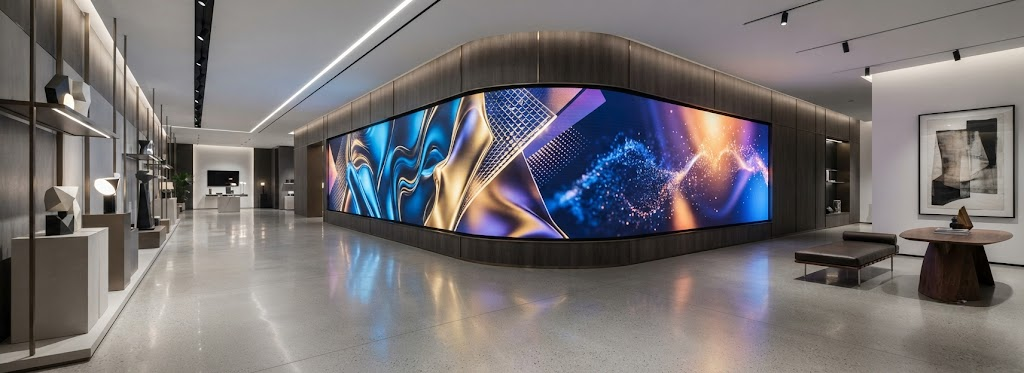
A major consideration for businesses is the appearance of the display itself. Indoor LED Video Displays can provide large, continuous viewing areas for corporate presentations, retail content, reception areas, auditoriums, and other indoor applications.
The absence of prominent screen borders can be particularly useful when displaying videos, graphics, presentations, or branded visual content across a large surface.
Flexible Screen Configurations
Traditional video walls can be arranged in different layouts, such as 2×2, 3×3, or wider configurations. This flexibility allows businesses to adapt the display to the dimensions of a particular wall.
LED displays offer another level of flexibility because the overall screen can often be designed according to the required dimensions. This can be useful when a standard television or monitor arrangement does not fit the available space.
Better Digital Communication
Businesses are also using large displays for more than advertising. They can show presentations, live feeds, dashboards, announcements, product demonstrations, event content, wayfinding information, and corporate communications.
The technology is therefore becoming part of a broader digital communication strategy rather than simply functioning as a large television.
Video Wall vs LED Display: What Is the Difference?
The simplest way to understand the difference is to look at how each display is constructed.
A traditional video wall is generally made by combining multiple individual display panels or commercial monitors. A video wall controller or processor manages the content and determines what appears across the screens.
An LED display, on the other hand, is made from LED modules or panels that work together to form one large display surface. Because there are no conventional monitor bezels separating each panel, the final appearance can be more continuous.
Both options have advantages. The better choice depends on the application.
Video Wall: When Does It Make Sense?
A video wall can be a practical choice when a business needs multiple screens working together. It can display one large image across several panels or show different content on different screens.
This makes video walls useful for:
- Control rooms
- Corporate offices
- Meeting rooms
- Conference areas
- Security monitoring
- Retail environments
- Reception areas
- Command and information centres
Businesses that need detailed content and multiple information sources may find a video wall particularly useful.
LED Display: When Is It Better?
LED displays can be a strong option when the priority is a large, continuous visual surface. They are especially useful when the screen needs to be significantly larger than conventional display formats.
LED technology can also provide strong brightness, making it suitable for environments where ambient lighting affects screen visibility.
For large branding areas, stages, auditoriums, retail environments, event spaces, and other applications requiring an expansive visual surface, LED can offer considerable flexibility.
Key Factors to Consider Before Choosing
There is no universal winner between a video wall and an LED display. The right solution depends on several practical factors.
Screen Size
Consider the physical dimensions of the wall first. If the requirement is relatively moderate, multiple commercial displays may be sufficient. For very large surfaces, LED technology may provide greater flexibility.
Viewing Distance
The distance between viewers and the display affects how the screen should be designed. People sitting close to the display may require a solution with appropriate pixel density and image detail.
For audiences viewing a large screen from farther away, the priorities can be different. Screen size, pixel pitch, and viewing distance should therefore be considered together.
Content Type
Think about what will actually appear on the screen.
Presentations, spreadsheets, text-heavy dashboards, security feeds, and detailed graphics may require a display with strong image clarity. Large promotional videos and branding visuals may place greater emphasis on screen size and visual impact.
Indoor or Outdoor Environment
Environmental conditions can significantly influence the choice. Indoor applications generally have different brightness, protection, and installation requirements from outdoor applications.
For indoor corporate or retail spaces, LED Video Wall Solutions can be selected according to the room size, ambient lighting, and viewing requirements.
Budget and Maintenance
The initial purchase price is only one part of the decision. Businesses should also consider installation, processors or controllers, cabling, power requirements, maintenance, replacement components, and future upgrades.
A lower initial cost does not always mean lower long-term cost. The complete system should be evaluated before making a decision.
Benefits of Choosing the Right Display
Better Visual Communication
A properly selected display makes information easier to see and understand. Whether the content is a presentation, product video, announcement, or dashboard, screen quality affects the overall communication experience.
Stronger Brand Presentation
Large-format displays can support brand recognition by giving businesses more space for visual content. Retail stores, corporate offices, hotels, and event venues can use digital displays to create a consistent visual environment.
Improved Visitor Experience
Digital displays can help visitors find information, understand services, view product demonstrations, or simply interact with engaging content. The technology becomes more valuable when it solves a real communication need.
Flexible Content Management
Modern display systems can support different types of content. Businesses can update presentations, campaigns, videos, announcements, or information without physically replacing printed materials.
Better Use of Available Space
A properly designed display can make use of an otherwise underused wall or presentation area. However, the screen should complement the room instead of overwhelming it.
For businesses comparing options, understanding the practical differences is more useful than choosing a technology simply because it appears more advanced. A detailed look at Video Wall vs LED Display: Which Is Better? can help readers understand where each solution fits different business requirements.
Common Mistakes Businesses Make
One common mistake is choosing a display based only on screen size. A larger display is not automatically better. If the viewing distance, content, or room dimensions are unsuitable, the result may not provide the expected experience.
Another mistake is ignoring the viewing environment. Lighting conditions, reflections, viewing angles, and audience movement can all affect how content appears.
Businesses may also overlook installation requirements. Weight, wall structure, ventilation, power supply, cable routing, and access for maintenance should be considered before installation begins.
Choosing technology without considering future content is another problem. A display designed mainly for presentations may not be ideal for a high-impact retail environment. Similarly, a large LED screen may provide unnecessary capability for a small meeting room.
Poor content design can also reduce the effectiveness of an excellent display. Small text, excessive information, low-contrast graphics, and unsuitable video formats can make content difficult to understand.
Finally, businesses should avoid selecting an installation provider based only on price. Relevant experience, technical understanding, installation quality, after-sales support, and previous work should also be considered.
Expert Tips Before Choosing Video Wall Installations
Start by defining the purpose of the display. Ask what problem it needs to solve and who will use it.
Next, measure the available space and identify the normal viewing distance. These two factors help determine the appropriate display size and configuration.
Consider the type of content that will be displayed. If the system will mainly show detailed presentations or data, image clarity may be a higher priority. If it will display large promotional visuals, screen size and brightness may become more important.
Lighting should also be evaluated. A screen placed in a bright showroom may require different specifications from one installed inside a controlled meeting room.
Businesses should also think about content management. Decide who will update the screen, how content will be delivered, and whether the system needs to connect with other devices.
Installation planning is equally important. Professional Video Wall Installation Services should account for mounting, alignment, cabling, power, ventilation, signal distribution, and accessibility for maintenance.
If the business operates across multiple locations, requirements may also differ from one site to another. For example, Video Wall Installation Services in Bangalore may need to account for a different building layout, viewing environment, or application compared with an installation in Coimbatore.
Experience is another useful selection factor. DESIGNEXT has 12+ Years of industry experience and has worked with 260+ Happy Clients. These details can be considered as part of a broader evaluation alongside technical capability, project understanding, and the ability to deliver a solution suited to the actual environment.
Most importantly, do not select technology before defining the requirement. The display should serve the business purpose, not become the purpose itself.
So, Which Is Better: Video Wall or LED Display?
Neither technology is automatically better in every situation.
A traditional video wall can be a suitable choice when a business needs multiple individual screens, detailed information, flexible content layouts, or applications such as monitoring and corporate presentations.
An LED display may be more appropriate when the priority is a very large, continuous visual surface, high-impact branding, or flexible screen dimensions.
The right decision comes down to screen size, viewing distance, content, environment, installation requirements, maintenance, and budget.
Businesses should compare these factors before making a final decision. A well-planned display solution will be more useful than simply choosing the newest or largest technology available.
Frequently Asked Questions
1. Is a video wall the same as an LED display?
No. A traditional video wall usually combines multiple individual displays into one larger visual system, while an LED display uses LED modules or panels to create a large display surface. Both can deliver large-format digital content but have different construction and application characteristics.
2. Which is better for a large commercial display?
It depends on the application. LED can be suitable for very large, continuous visual surfaces, while a video wall can work well when multiple individual screens and flexible content layouts are required.
3. Are LED displays suitable for indoor business environments?
Yes. Indoor LED Video Displays can be used in offices, retail stores, reception areas, conference spaces, auditoriums, and other indoor environments when the specifications are selected according to viewing distance, brightness, and content requirements.
4. What should I consider before installing a video wall?
Consider the available wall space, viewing distance, content type, ambient lighting, screen size, power requirements, mounting structure, signal sources, maintenance access, and budget. Professional planning can help avoid installation and usability problems later.
5. Do businesses need Professional Video Wall Installation Services?
Professional installation can be valuable when the project involves multiple displays, large LED panels, complex signal distribution, structural mounting, or content management equipment. Proper installation helps ensure alignment, connectivity, stability, and reliable operation.
Conclusion
The choice between a video wall and an LED display should be based on the business's actual needs rather than a simple question of which technology is newer or bigger. Both options can provide effective digital communication when properly planned.
Before investing, consider the environment, audience, viewing distance, content, screen dimensions, installation requirements, and long-term maintenance. With the right planning, large-format display technology can improve communication, strengthen visual presentation, and create a more useful experience for customers and visitors.