
Exhibition Branding vs Traditional Marketing
In a competitive business environment, getting attention is only the first step. Businesses also need to create a clear and memorable impression that helps people understand what they offer. This is where Trade Expo Branding becomes important. Unlike traditional marketing methods that often communicate through advertisements, brochures, or digital campaigns, exhibition branding gives businesses a physical space where customers can see, experience, and interact with the brand.
For businesses participating in exhibitions in Coimbatore, the difference between these approaches can have a practical impact. A well-planned exhibition presence can combine visual communication, product presentation, visitor interaction, and brand identity in one place. Understanding the strengths and limitations of each approach helps businesses decide where their marketing efforts should be focused.
Why This Topic Matters
Traditional marketing includes channels such as newspapers, television, outdoor advertising, email campaigns, social media, brochures, and online advertising. These methods can help businesses reach a broad audience, but the interaction is often limited to a short message or visual impression.
Trade Show Branding, on the other hand, creates a physical environment where the audience can spend time with the brand. Visitors can walk into a booth, ask questions, see products, watch demonstrations, scan QR codes, and speak directly with representatives. This makes the experience more interactive than many conventional advertising formats.
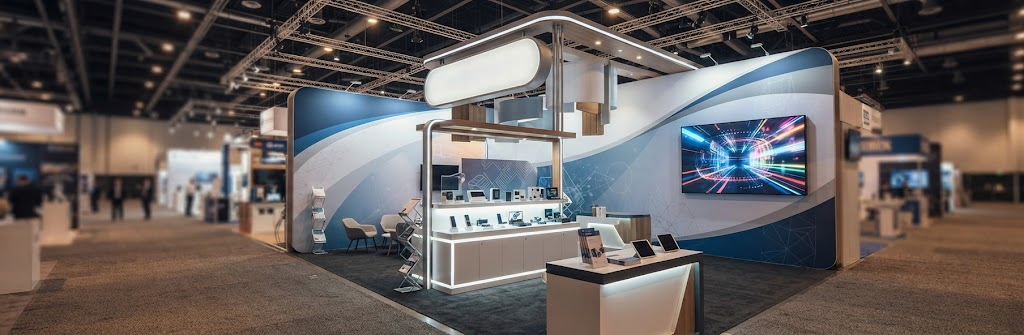
First impressions also matter strongly at exhibitions. Visitors may see dozens of exhibitors during a single event. A booth with clear branding, readable messaging, suitable lighting, and an organised layout can make it easier for people to recognise the company and understand its offering.
For example, a technology company attending an industry exhibition could use its booth to display its main solutions, demonstrate a product on a screen, provide QR access to detailed information, and allow visitors to speak with its team. Instead of communicating through one advertisement, the company creates several connected touchpoints.
Planning is therefore essential before an exhibition. Businesses should decide what they want visitors to remember, which products deserve attention, and what action visitors should take after engaging with the brand.
Current Trends and Developments in Trade Expo Branding
Exhibition environments are becoming more focused on clarity, interaction, and visitor experience. Modern Exhibition Stall Branding is not simply about placing a large logo on a wall. The complete space should communicate the brand in a consistent and easy-to-understand way.
One noticeable development is the use of digital screens and multimedia. Businesses can use displays to present product videos, demonstrations, company information, or visual presentations. Digital content can be particularly useful when a product is difficult to explain through static graphics alone.
QR codes are another practical addition. A visitor can scan a code to access a product catalogue, enquiry form, website page, presentation, or contact information. This connects physical exhibition branding with digital communication without requiring large amounts of printed material.
Interactive experiences can also make a booth more engaging. Depending on the industry, this may include product demonstrations, touch-screen displays, samples, live presentations, or simple activities related to the product. The objective should not be technology for its own sake. Every interactive element should have a clear purpose.
Sustainable materials and reusable booth components are also becoming more relevant for businesses planning repeated exhibitions. Reusable structures, modular displays, and carefully selected graphics can help businesses create a consistent presence across different events while reducing unnecessary replacement.
Lighting and space planning continue to play an important role. Well-positioned lighting can draw attention to products, logos, reception areas, or important messages. At the same time, the booth should leave enough space for visitors to move comfortably.
A successful Trade Exhibition Brand Promotion strategy brings these elements together. The design, messaging, technology, products, and staff interaction should feel like parts of the same brand experience.
Benefits of Trade Expo Branding
Better Brand Visibility
A physical exhibition booth gives a company a dedicated space where its identity can be displayed consistently. Large but readable branding, suitable graphics, and clear messaging can help visitors identify the business from a distance.
Visibility is especially important when several companies are offering similar products or services. A well-organised presentation can make the brand easier to notice without relying on excessive decoration.
Stronger First Impressions
Traditional advertisements usually provide limited time for communication. At an exhibition, visitors can experience the brand environment directly.
A professional booth can communicate qualities such as attention to detail, organisation, and confidence. However, appearance should support the business message rather than replace it. A visually attractive booth with unclear information may not achieve its purpose.
Improved Visitor Engagement
One of the major advantages of exhibition marketing is direct interaction. Visitors can ask questions and receive immediate answers.
Product demonstrations are particularly useful when customers need to understand how something works. A manufacturing company, for example, may demonstrate a machine or display a working component rather than simply describing it through printed advertising.
Clear Communication
Good Trade Expo Branding helps visitors understand the most important information quickly. The company name, key offering, major benefits, and call to action should be easy to identify.
Instead of filling every wall with text, businesses can use short messages, graphics, product visuals, and supporting information. Detailed information can then be provided through brochures, QR codes, or conversations with the team.
Better Brand Recognition
Consistency helps people connect the exhibition experience with the wider business. Colours, typography, logos, imagery, messaging, and product presentation should align with the company's established identity.
This is one reason exhibition branding should be planned as part of the overall marketing strategy rather than treated as an isolated event activity.
Support for Lead Generation
An exhibition can create opportunities for direct enquiries. A simple registration process, QR-based enquiry form, product demonstration, or conversation with a sales representative can help businesses identify interested visitors.
However, collecting contacts is only one part of the process. Businesses should also plan how enquiries will be organised and followed up after the event.
Common Mistakes Businesses Make
Using Too Much Information
One of the most common problems is overcrowded booth graphics. When visitors see long paragraphs, multiple messages, and too many images, they may struggle to understand the main point.
Businesses should prioritise the information that matters most and move detailed explanations to brochures, digital screens, or conversations.
Weak or Unclear Messaging
A visitor should be able to understand what the business does without spending several minutes decoding the booth.
A simple headline, supporting message, and clear product or service presentation can be more effective than complicated wording.
Inconsistent Branding
Using different fonts, colours, images, or messaging across the booth can make the brand appear disconnected. Exhibition Stall Branding should maintain visual consistency from the entrance to the reception counter and digital displays.
Ignoring Visitor Movement
A booth may look impressive but still feel uncomfortable if the layout is poorly planned. Businesses should consider where visitors enter, where products are displayed, where conversations happen, and how people move through the space.
Choosing Appearance Over Purpose
A visually impressive booth is not automatically an effective marketing space. Every major design element should support a business objective, such as attracting attention, explaining a product, encouraging interaction, or generating enquiries.
Forgetting Follow-Up
The exhibition does not end when the booth is dismantled. Visitor enquiries should be reviewed and followed up appropriately. A strong exhibition experience can lose value if interested prospects receive no response afterwards.
Expert Tips Before Choosing or Using Trade Expo Branding
Start by defining the purpose of the exhibition. Are you launching a product, generating leads, building awareness, meeting existing customers, or entering a new market? The answer should influence the booth design and communication.
Next, understand the target audience. Different visitors respond to different messages. A technical audience may want product specifications and demonstrations, while business decision-makers may be more interested in applications, benefits, and commercial value.
Choose one clear central message. Visitors should not have to read everything on the booth to understand the main offering. Keep the primary communication short and support it with relevant visuals.
Plan the booth layout before production begins. Consider visibility from different directions, visitor movement, product placement, meeting areas, storage, lighting, and screen positions.
Maintain consistent branding across every element. Your booth should look like an extension of your existing brand rather than a completely separate design.
Technology should also be selected based on purpose. A digital screen, QR code, or interactive display can be useful when it improves communication. If it adds complexity without helping visitors, it may not be necessary.
Budget and timeline should be considered early. Exhibition projects involve design, production, printing, installation, transportation, and event schedules. Early planning provides more time to review the design and make practical adjustments.
When selecting a service provider, review relevant experience and previous work. For businesses looking for Trade Expo Branding Services in Coimbatore, it is useful to assess whether the provider understands exhibition environments, brand communication, space planning, and production requirements rather than judging a design only by appearance.
DESIGNEXT brings 12+ Years of industry experience and has worked with 260+ Happy Clients. Such experience can be useful when evaluating how branding requirements translate into a practical exhibition environment. The final choice, however, should always be based on the specific business objective, audience, event requirements, budget, and expected visitor experience.
For businesses comparing different approaches, Exhibition Branding vs Traditional Marketing is not necessarily a question of choosing one and completely ignoring the other. Traditional marketing can create awareness before an event, while exhibition branding can provide a deeper physical experience during the event. Using both strategically can create a more connected customer journey.
How to Choose the Right Approach
The right marketing approach depends on the objective. If the goal is to reach a large audience repeatedly through a broad campaign, traditional marketing may be suitable. If the objective is to demonstrate a product, meet potential customers, create face-to-face conversations, or build a memorable event presence, exhibition branding can offer stronger opportunities for direct engagement.
Businesses should also consider the nature of the product. Products that benefit from demonstration or physical inspection may gain more value from exhibitions. Services that require detailed discussion can also benefit from a dedicated meeting environment.
The most effective strategy is often a combination. Businesses can use digital campaigns, email communication, social media, and other traditional channels to attract attention before an exhibition. The booth can then reinforce the same message through physical branding, demonstrations, and personal interaction.
Frequently Asked Questions
1. What is the difference between exhibition branding and traditional marketing?
Exhibition branding creates a physical brand experience at an event, while traditional marketing generally communicates through channels such as print, television, outdoor advertising, or other established promotional formats. Exhibition branding allows visitors to interact directly with the company, products, and representatives.
2. Is Trade Expo Branding useful for small businesses?
Yes. Small businesses can use Trade Expo Branding to present their products professionally, meet potential customers, demonstrate solutions, and build awareness. The booth does not need to be large to be effective. Clear messaging and thoughtful space planning are often more important than size.
3. What should an exhibition booth communicate?
An exhibition booth should clearly communicate the company name, main products or services, key value proposition, and an appropriate next step for visitors. Supporting elements such as demonstrations, screens, brochures, or QR codes can provide additional information.
4. How can businesses improve visitor engagement at exhibitions?
Businesses can use product demonstrations, interactive displays, samples, clear conversations areas, QR codes, and relevant digital content. The most useful approach depends on the audience and product. Interaction should make it easier for visitors to understand or experience the offering.
5. How do I choose the best provider for exhibition branding?
When searching for the Best Trade Expo Branding Company, businesses should review previous relevant projects, understand the provider's production capabilities, discuss timelines and budgets, and check whether the proposed solution matches the event objective. Experience in exhibition environments is also important because design must work in a real physical space, not just in a presentation.
Conclusion
Exhibition branding and traditional marketing serve different purposes, but both can play an important role in a business marketing strategy. Traditional channels can help create awareness and reach people before an event, while a well-planned exhibition presence gives businesses an opportunity to communicate face-to-face and create a memorable brand experience.
Effective Trade Expo Branding is not only about making a booth look attractive. It is about clear messaging, consistent branding, practical space planning, visitor engagement, and presenting products or services in a way that is easy to understand. Businesses that plan these elements around their audience and exhibition goals can make better use of their event participation.
For companies preparing for exhibitions in Coimbatore, the key is to choose an approach that matches the business objective, audience, budget, and event environment. When physical branding and other marketing channels work together, the exhibition can become a meaningful part of the overall customer journey.