
Custom Exhibition Stall vs Modular Exhibition Stall
Choosing the right exhibition stall is an important decision for any business planning to participate in a trade show, expo, or industry event. The stall is more than a physical space. It represents your brand, displays your products, guides visitors, and creates the first impression of your business. When comparing Exhibition Stall Fabrication Services, two common options are custom exhibition stalls and modular exhibition stalls.
For businesses in Coimbatore and other competitive markets, understanding the difference between these two options can make exhibition planning easier. Both have their own advantages, limitations, costs, and design possibilities. The right choice depends on your exhibition goals, available space, budget, branding requirements, and how often you plan to participate in events.
Why This Topic Matters
Exhibitions bring several businesses together in the same environment. Visitors may walk past dozens of booths before deciding where to stop. A well-planned stall can therefore make it easier for people to notice your brand and understand what you offer.
This is where good Exhibition Stall Fabrication becomes important. The structure, graphics, lighting, product displays, meeting areas, storage, and visitor flow should work together rather than being designed separately.
Customer expectations have also changed. Visitors are not only looking for attractive booths. They expect clear information, easy navigation, useful product demonstrations, and an experience that feels professional. A business selling industrial equipment, for example, may need demonstration areas and technical displays, while a consumer brand may need stronger visual presentation and product interaction.
Brand recognition is another important consideration. Your exhibition space should reflect your existing logo, colours, typography, messaging, and overall identity. Consistency helps visitors connect the physical booth with the brand they may already know through other channels.
Planning also matters because exhibition stalls involve several practical decisions. Space dimensions, venue rules, electrical requirements, graphics, installation schedules, transportation, furniture, and dismantling all need attention before the event. Choosing between a custom and modular approach at the beginning can make these decisions much easier.
Custom Exhibition Stall vs Modular Exhibition Stall: What Is the Difference?
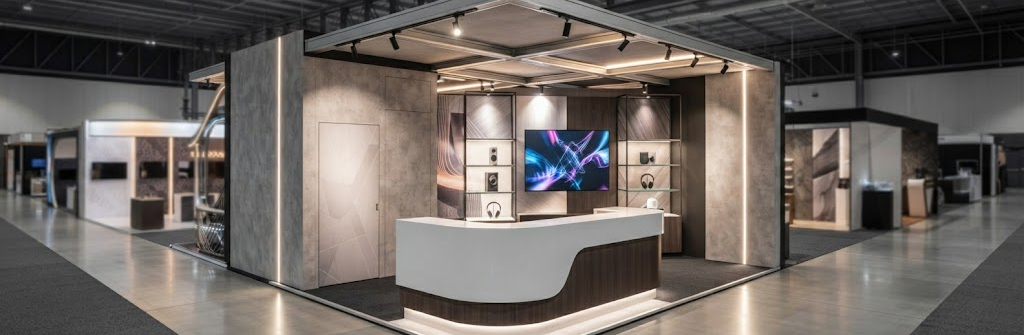
A custom exhibition stall is designed specifically for a particular brand, exhibition space, and business requirement. The structure can be planned around the available dimensions, brand identity, product display requirements, meeting areas, storage, lighting, and visitor movement.
A modular exhibition stall uses prefabricated or reusable components that can be assembled in different configurations. Instead of creating every structural element from scratch for one event, businesses can reuse selected components and adjust the layout according to the available space.
Neither option is automatically better. The better choice depends on what the business wants to achieve.
Custom Exhibition Stalls
A custom stall provides greater freedom in terms of shape, layout, branding, and visual presentation. If a company wants a distinctive structure that reflects its brand personality, a Custom Exhibition Stall Design can provide more flexibility.
For example, a technology company may want integrated digital screens, product demonstration counters, private discussion areas, and an unusual architectural element. A custom approach allows these requirements to be considered together during the design stage.
Custom stalls are particularly useful when the exhibition is strategically important or when the business wants its booth to create a strong visual identity.
Modular Exhibition Stalls
Modular stalls focus on flexibility and reuse. Components can often be assembled, rearranged, transported, and used at different events.
This can be practical for businesses that attend multiple exhibitions throughout the year. A modular system may be configured differently depending on whether the next event provides a small inline space, a corner booth, or a larger open area.
Modular construction can also simplify future planning because some components are already available. However, the final appearance still depends on the quality of the design, graphics, materials, lighting, and layout.
Current Trends and Developments in Exhibition Stall Fabrication Services
Modern exhibition environments increasingly focus on visitor experience rather than decoration alone. A successful booth needs to communicate quickly and make it easy for visitors to interact with the brand.
One noticeable trend is the use of clean and minimal layouts. Instead of covering every wall with text, businesses are using stronger headlines, focused graphics, product visuals, and clear calls to action. This makes important information easier to understand from a distance.
Digital displays are also becoming useful in exhibition environments. LED screens, interactive displays, videos, and presentations can demonstrate products or explain complex services without requiring large amounts of printed content. However, technology works best when it supports the message rather than becoming the main attraction.
QR codes can provide another connection between physical and digital experiences. A visitor can scan a code to access a product catalogue, enquiry form, company website, product demonstration, or additional information.
Sustainable and reusable materials are also worth considering. Modular structures, reusable graphics, recyclable materials, and components that can be used at multiple events can help businesses reduce unnecessary waste and repeated fabrication.
Lighting remains an important part of Professional Exhibition Booth Construction. Properly positioned lighting can highlight products, improve readability, define important areas, and create a more inviting environment. The objective should be visibility and usability rather than excessive decoration.
Benefits of Exhibition Stall Fabrication Services
Better Brand Visibility
A professionally planned stall gives the brand a defined physical presence within a busy exhibition hall. Clear signage, suitable graphics, lighting, and a logical layout can help visitors identify the company more easily.
For example, placing the company name and primary message where they can be seen from the main aisle can make the booth easier to recognise.
Greater Design Flexibility
Custom fabrication offers businesses the ability to design the space around their specific objectives. Product displays, counters, storage, meeting areas, screens, and branding can be integrated into one layout.
This is especially useful when a business has unusual products or specific presentation requirements.
Reusability and Flexibility
Modular exhibition systems provide a practical advantage for businesses attending several events. The same basic components can potentially be adapted to different booth sizes and configurations.
This makes modular solutions worth considering when long-term flexibility is more important than creating a completely unique structure for every exhibition.
Better Visitor Experience
A good booth should make visitors feel comfortable and help them understand where to go. Open entrances, clear product zones, comfortable discussion areas, and sensible visitor movement can make the space easier to use.
The best Exhibition Stall Fabrication Services consider the visitor journey as part of the design rather than treating the stall as a decorative structure.
Clear Product Communication
An exhibition stall should answer basic questions quickly: Who is the company? What does it offer? Why should visitors be interested?
Strong visual hierarchy helps communicate these points. Important information should be visible first, while detailed information can be provided through brochures, screens, QR codes, or staff discussions.
Custom or Modular: Which One Should You Choose?
The decision becomes easier when you compare the two options against your actual requirements.
Choose a custom stall when:
- You need a highly distinctive design.
- The exhibition is strategically important.
- Your products require specialised displays.
- You need a specific combination of meeting, storage, and demonstration areas.
- Strong architectural branding is a priority.
- The booth has a unique shape or unusual space requirement.
Consider a modular stall when:
- You attend multiple exhibitions.
- You want reusable components.
- Your booth size may change between events.
- Flexibility is more important than a completely unique structure.
- You want a system that can be adapted for future exhibitions.
In some cases, businesses can also combine both approaches. A modular structural system can be enhanced with custom graphics, lighting, counters, display elements, and branded features. This creates a balance between flexibility and visual identity.
Before selecting a provider, businesses can also explore Custom Exhibition Stall vs Modular Exhibition Stall options in detail to understand how the two approaches may fit different exhibition requirements.
Common Mistakes Businesses Make
Designing Only for Appearance
An attractive booth is useful, but appearance alone does not guarantee a good visitor experience. A beautiful structure with poor navigation or unclear messaging may fail to communicate effectively.
The design should balance aesthetics with function.
Using Too Much Information
Large blocks of text can make exhibition graphics difficult to read. Visitors often see a booth while walking past it, so important information should be concise and visually organised.
Use short messages, strong visuals, and clear headings.
Ignoring Visitor Movement
Placing furniture, counters, or displays in the wrong positions can make the booth feel crowded. Before finalising the layout, consider how visitors will enter, move through the space, interact with products, and leave.
Choosing Materials Without Considering Reuse
For businesses attending multiple events, selecting materials only for one exhibition may increase future costs and create unnecessary waste. Reusability should be considered during the initial planning stage.
Leaving Fabrication Until the Last Minute
Design approval, production, printing, transportation, installation, and venue coordination all require time. A rushed schedule can create avoidable problems.
Starting early gives the business enough time to review drawings, graphics, dimensions, and technical requirements.
Expert Tips Before Choosing Exhibition Stall Fabrication Services
Start by defining the purpose of the exhibition. Are you launching a product, meeting distributors, demonstrating equipment, generating enquiries, or strengthening brand awareness? The answer should influence the stall layout.
Next, understand the target audience. A technical audience may need detailed product demonstrations, while a general audience may respond better to simple visual communication and interactive displays.
Identify one main message for the booth. Visitors should be able to understand what your business does without reading every panel.
Plan the layout before selecting decorative elements. Allocate space for products, reception, demonstrations, discussions, storage, and visitor movement. This prevents the design from becoming crowded.
Maintain brand consistency across the entire booth. Your logo, colours, graphics, messaging, and digital content should look like part of the same brand system.
Choose materials according to the exhibition schedule and intended reuse. If you participate regularly, discuss whether a modular structure or reusable components could be practical.
Lighting should also be planned early. Product areas, logos, display shelves, and important graphics may require different lighting levels.
If you are considering Exhibition Stall Fabrication Services in Coimbatore, review the provider's previous work, fabrication capabilities, relevant experience, material options, installation process, and ability to work within venue requirements. Do not judge a provider only by the appearance of a few photographs. Ask whether their approach matches your actual exhibition needs.
Experience can also help during planning. DESIGNEXT brings 12+ Years of experience to exhibition-related design and fabrication work, with 260+ Happy Clients. Such experience can be useful when evaluating practical decisions such as layout, materials, installation, and visitor flow.
Finally, create a realistic timeline. Allow time for design revisions, artwork approval, fabrication, testing, transportation, and installation. Good planning reduces last-minute decisions and gives the business more control over the final result.
Frequently Asked Questions
1. What is the main difference between a custom and modular exhibition stall?
A custom exhibition stall is designed specifically around a brand, space, and event requirement. A modular stall uses reusable components that can be assembled and adapted for different exhibitions. Custom solutions generally offer greater design freedom, while modular solutions focus more on flexibility and reuse.
2. Is a modular exhibition stall suitable for multiple events?
Yes. Modular stalls are particularly useful for businesses that participate in several exhibitions. Components can often be rearranged or combined differently depending on the available booth size and event requirements.
3. Are custom exhibition stalls better for branding?
Custom stalls can provide greater freedom for distinctive branding because the structure, graphics, lighting, and display areas can be designed together. However, a well-designed modular stall can also provide strong and consistent brand visibility.
4. How early should exhibition stall fabrication be planned?
It is better to start as early as possible because exhibition projects involve design, approvals, artwork, fabrication, logistics, and installation. The exact timeline depends on the stall size, complexity, materials, and event requirements.
5. How do I choose the right exhibition stall fabrication approach?
Start with your exhibition objective, booth size, number of events, branding requirements, product display needs, budget, and desired level of reuse. Compare these factors before deciding between a custom, modular, or hybrid solution.
Conclusion
The choice between a custom exhibition stall and a modular exhibition stall should be based on business requirements rather than appearance alone. Custom stalls provide greater freedom for unique designs and specialised experiences, while modular stalls offer flexibility and reusability for businesses attending multiple events.
Whichever option you choose, effective Exhibition Stall Fabrication should combine branding, functionality, visitor movement, product presentation, lighting, and practical installation requirements. With clear planning and the right design approach, an exhibition space can communicate your business effectively while giving visitors a comfortable and memorable experience.